
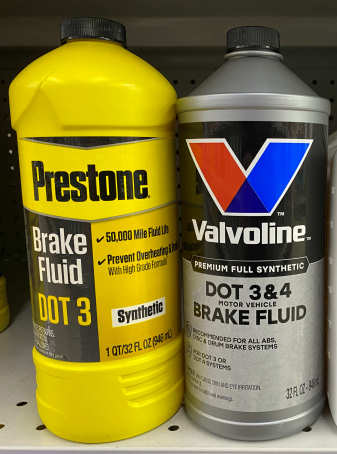
It was a Friday afternoon in May 1998. Traffic was heavy with people headed north for the Memorial Day weekend. A pickup truck pulling a travel trailer was in stop-and-go traffic approaching the Zilwaukee bridge on I-75--repeatedly applying the brakes as he moved along due to heavy traffic. Suddenly, as he put his foot on the brake, the pedal went to the floorboard and he crashed into the car in front of him. Little did he know that he was the victim of a perfect storm. When the responding policeman interviewed him, he swore that the brakes did not work--the pedal went right to the floor and he couldn't stop. When the policeman entered the pick-up truck and tested the brakes, the brake pedal functioned normally.
The result: a ticket and a lawsuit.
Investigative Mechanics was called upon to investigate the incident.
When the pick-up driver pressed on the brake pedal, it went right to the floor with little resistance. But when the officer put his foot on the brake pedal, there was sufficient resistance with the brake pedal high and firm.
We suspected fluid boil, a condition that supports a high level of moisture within the hydraulic system--which proved to be the case.
Fluid boil is a condition where moisture collects in the hydraulic braking system over time due to brake fluid hygroscopy. When it reaches a point of saturation AND when the braking system reaches a temperature over 284°F, the water turns into water vapor. Since gas compresses more than brake fluid, it takes more force and more brake pedal travel to compress the gas-permeated fluid and it does not maintain the required hydraulic pressure needed to engage the braking system at each wheel--a condition called fluid boil.
As it turned out, during the time between when the accident occurred and when the police arrived at the scene (and the officer performed his test on the brake pedal), enough time had passed for the brake fluid to cool down. By then, the moisture had returned to its liquid state. Thus, the braking system appeared to operate normally. The officer putting his foot on the brake pedal was an insufficient test which produced an inaccurate result. The brake fluid really needed to be tested for its moisture content.
But why do these situations occur?
Brake fluid is used to transfer force into pressure and to amplify braking force. It works because liquids are not appreciably compressible. In their natural state, the component molecules do not have internal voids and since the molecules pack together well, bulk forces are directly transferred to compress the fluid's chemical bonds.
As brake fluid is subjected to very high temperatures, especially in the wheel cylinders of drum brakes and disc brake calipers, it must have a high boiling point to avoid vaporizing in the lines. This vaporization creates a problem because vapor is highly compressible relative to liquid, and therefore negates the hydraulic transfer of braking force. Through microscopic pores in the rubber brake hoses (and removing the fill cap to check the fluid level), moisture enters the brake fluid and the boiling point of the brake fluid drops significantly - therefore, the brakes will fail to stop the vehicle. But I'll speak more about that shortly.
The wet boiling point, which is much lower (although above most normal service temperatures), refers to the fluid's boiling point after absorbing a certain amount of moisture.
This is several (single digit) percent, varying from formulation to formulation. Glycol-ether (DOT 3, 4, and 5.1) brake fluids are hygroscopic (water absorbing), which means they absorb moisture from the atmosphere under normal humidity levels.
Non-hygroscopic fluids (e.g. silicone DOT 5 and mineral oil based formulations), are hydrophobic, and can maintain an acceptable boiling point over the fluid's service life.
| Dry boiling point | Wet boiling point | Viscosity limit | Primary constituent | |
| DOT 3 | 205°C (401°F) | 140°C (284°F) | 1500 mm2/s | glycol ether |
| DOT 4 | 230°C (446°F) | 155°C (311°F) | 1800 mm2/s | glycol ether/borate ester |
| LHM+ | 249°C (480°F) | 249°C (480°F) | 1200 mm2/s | mineral oil |
| DOT 5 | 260°C (500°F) | 180°C (356°F) | 900 mm2/s | silicone |
| DOT 5.1 | 260°C (500°F) | 180°C (356°F) | 900 mm2/s | glycol ether/borate ester |
As compressibility increases, more brake pedal travel is necessary for the same amount of brake caliper piston force.
You might also expect that once the brake fluid reservoir cap is screwed on tight, there is no chance of water getting into the vehicles brake fluid. But in fact, plastic is porous to a small degree and hence the rubber brake lines and plastic reservoir will allow a tiny amount of moisture to pass through it.
Now when the brake fluid is compromised by moisture, it sets the stage for brake failure under certain conditions. Under hard braking conditions, the temperature within the braking system will rise to a point where the moisture will convert to its gaseous state, resulting in the brake fluid being permeated with gas bubbles. And as the gas has a higher level of compressibility, the brake pedal will travel further before enough pressure is achieved to activate the braking system. This leads to vapor lock with problems like longer stopping distances and brake failure.
The fact that glycol fluids gradually degrade in quality over time as water is absorbed is the reason that hydraulic braking systems must be periodically flushed through with new fresh brake fluid in order to maintain good braking performance. On a typical road car, replacing the fluid every 3 years is considered the minimum but the conditions under which the vehicle is driven also play a factor here.
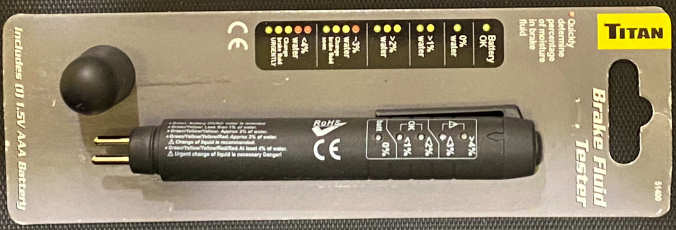
The Titan Pen Tester is a simple and portable device that checks for fluid quality. About the size of a pen, you stick the two probes into brake fluid and it will determine an approximate value of the moisture content in terms of a percentage -- displayed by the LEDs on the side of the pen. If the LED is green, then it measured 0% water. As moisture content increases, the LEDs progress from Green to Yellow to Red, measuring from 0% to 4%+ water content in the brake fluid.
When we want to know the specific boiling point of the brake fluid, we bring out the Wagner F300450 Brake Fluid Moisture Tester.
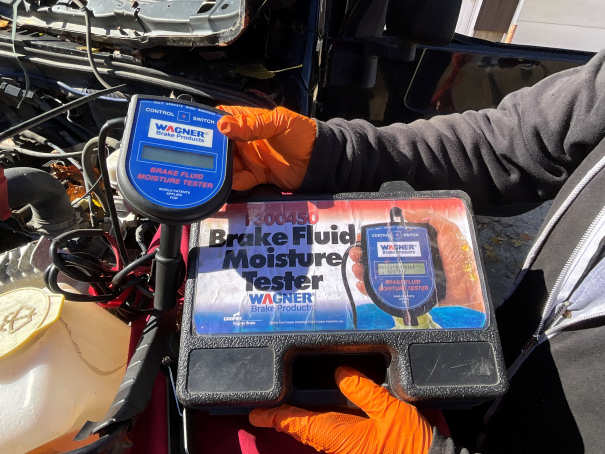
As expected, this device is larger and more sophisticated than the Titan Pen Tester. The Wagner Tester uses its probe to measure the actual boiling point of the brake fluid and display those results on its high-precision digital display screen in a numeric format.
This device is designed to detect and test DOT 3, DOT 4, and DOT 5.1 brake fluids. It also utilizes an alarm system which notifies users if the brake fluid contains impurities or if the fluid's quality is low.
And this is why, in cases where there is a reported brake failure, we make it a point to test the moisture content of the brake fluid with our equipment. Doing so helps narrow down that point of failure within the braking system and it helps us determine whether the incident was driver error or the result of a mechanical failure.
But what other contaminants can hinder a vehicle's braking system? Next time, I'll talk about microbial growth, the importance of flushing your braking system on a scheduled basis, and some of the tools we use during a brake inspection.
Our firm is conveniently located in central Michigan making it readily possible to provide immediate service to our clients throughout the Midwest, United States and abroad.
13925 Main Street - P.O. Box 340
Bath, Michigan 48808-0340
office: 517-641-6600
fax: 517-641-7300
e-mail: bwilson@investigativemechanics.com